 DuckSave
Saving when your income
is never the same twice
Take a share out of every payment, the moment it lands, instead of waiting to see what is left at the end of the month. A good month saves more, a quiet month saves less. It never asks for money you have not been paid yet, which is the one reason it works for people whose income moves.
here Written by HUMBURRER (ณัฐพล เนี่ยงจิต)
I make DuckSave · Updated 20 November 2026
What the percentage method is
Instead of deciding you will save $500 a month, you decide you will save 10% of everything that comes in. Paid $2,000, save $200. Paid $6,000, save $600. However many times money arrives, that is how many times you split it.
The difference that matters is not the number. It is the timing — this method saves when the money arrives, not at the end of the month, because what is left at the end of the month usually is not left.
A fixed amount asks for money you may not have yet. A percentage asks for money already in your hand.
Saving 10% of your income: what that comes to
This is what gets split off each time money arrives. The last column is a year of saving 10%, if every month brought in the same.
| This payment | Save 5% | Save 10% | Save 15% | Save 20% | 10% for a year |
|---|---|---|---|---|---|
| $2,000 | $100 | $200 | $300 | $400 | $2,400 |
| $3,000 | $150 | $300 | $450 | $600 | $3,600 |
| $4,000 | $200 | $400 | $600 | $800 | $4,800 |
| $6,000 | $300 | $600 | $900 | $1,200 | $7,200 |
| $10,000 | $500 | $1,000 | $1,500 | $2,000 | $12,000 |
Rounded down. Interest not included.
What percentage is the right one
The number you hear most is 10%, and it is a fine place to start. But the right percentage is the one you can hold for months in a row, not the one that looks good the day you set it.
Do not start at a number you have never managed before. Starting at 20% and stopping in month two leaves you with less than starting at 5% and finishing the year.
Freelancers and shop owners
This is the group the method was built for. Here is someone whose last three months were nothing alike, saving 20% every time money came in.
| Month | Came in | Saved 20% | Left to spend |
|---|---|---|---|
| A quiet month | $2,500 | $500 | $2,000 |
| A normal month | $5,000 | $1,000 | $4,000 |
| A busy month | $9,000 | $1,800 | $7,200 |
| Three months | $16,500 | $3,300 | $13,200 |
Had this person set a fixed $1,000 a month instead, the quiet month breaks immediately — and by the research on quitting, the first miss is where most people stop. On a percentage, the quiet month still works. It just saves less. What matters is that they have not quit.
What it is good at, what it costs you, and who it suits
- It never asks for money you have not been paid, so no payment is impossible
- A good month saves more on its own, with no plan to rewrite
- When your income rises, the amount rises the same day, with no decision to make
- There are no empty boxes to see, because there are no scheduled payments
- It saves at the moment money arrives, before you have attached it to anything
- A quiet month saves almost nothing
- You can never know the total in advance, so you cannot say when you will reach a goal
- No automatic transfer. You have to split it yourself every time
- You have to know what you were actually paid each time. No record, no method
- A flat percentage may not be enough when your income swings hard
- You freelance, or take work by the job, and no two months match
- You run a shop, where money comes in daily but never the same
- You have several sources of income arriving at different times
- You have set a fixed amount before and could not make it in a tight month
- Your income is climbing
- You need an exact sum by an exact date, like tuition
- You want to set an automatic transfer and never think about it
- You do not want to write down what you were paid
- Your income is already very steady, in which case a fixed amount is simpler
What the research says
An uneven income is not a minority problem. The typical family met large income swings in nearly five months of the year, and income spiked up about twice as often as it dropped. Planning on the assumption that every month brings the same amount is an assumption that does not match most people to begin with.
At the first company to run it, people who joined raised their savings rate from 3.5% to 13.6% of pay in under four years, and 78% of those offered it joined.
Raise the percentage when the income rises. At that moment you are not used to the new money yet, so nothing feels lost.
Where the same research argues against this
I think a page that recommends a method should also say what the research it is quoting argues against.
Three things to know
- A flat percentage can leave you under-prepared. The JPMorgan Chase researchers say so themselves, and recommend saving harder in the months income spikes. So in a busy month, do not stop at the usual percentage — put the extra away too.
- Both of these are US data. The 36% and the six weeks come from American bank accounts, and Save More Tomorrow ran at American employers. For this page that is the right country — but if you are reading from elsewhere, the figures are not yours.
- Save More Tomorrow is about salaried employees, which is the opposite of the people this page is for. I use only its lesson about raising the percentage when income rises. I do not borrow its numbers for freelancers.
Setting a goal when you cannot know the total
This is the flaw in the method that cannot be fixed — you cannot say when you will arrive. But it can be worked around, by changing what you measure.
What I made for you
A savings log
you can print
This method needs you to write down what you were paid each time, or there is nothing to split. The sheet has a column for the date, where the money came from, how much, and the running total. Nothing has to be filled in to be complete, because no two months bring in the same anyway.
Let the app count it instead
Or let DuckSave work it out
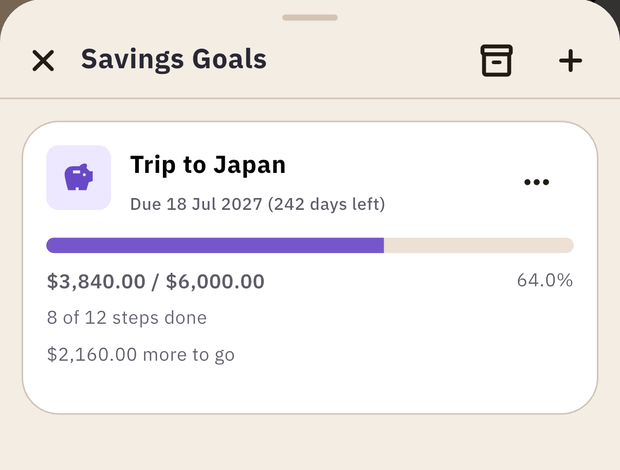
Set a goal and pick A share of what comes in, put in the percentage you want to keep, and the app works the amount out from the income you have recorded. The running total is there every time. Offline. Free, no sign-up needed.
If your income is steadier than that,
one of the other three may fit
All four live in the same app, and you can switch at any time without starting the goal over.
Same amount every time
A little less each time
Save freely
Research cited on this page
- JPMorgan Chase Institute (2019). Weathering Volatility 2: A Monthly Stress Test to Guide Saving.
- Thaler, R. H., & Benartzi, S. Save More Tomorrow: Using Behavioral Economics to Increase Employee Saving · figures as summarised by Chicago Booth Review (2013).
This page is a tool for building a saving habit, not investment advice. Every number in the tables is worked out from the formula by a program and checked, with no interest included. If I have read a study wrong, tell me.