 DuckSave
People quit saving after the first miss,
not because they ran out
Saving freely means no chart, no set amount, and no schedule — put in what you want, when you want. It sounds like the method for people with no discipline. But the research on goals keeps pointing the same way, so I think it deserves to exist, and this page is the reason why.
here Written by HUMBURRER (ณัฐพล เนี่ยงจิต)
I make DuckSave · Updated 20 November 2026
When people quit, and what the research says
The two explanations you hear most are “no discipline” and “not enough money”. The research on sticking to goals points somewhere else — the point people come off is the first day they cannot do it, not the day the money runs out.
The group on a hard goal, where falling short simply counted as a miss, succeeded the next day at 0.37. The group whose goal had room to miss built into it succeeded at 0.55.
A missed day does not only cost you that day. It decides whether there is a next one.
What makes people quit is seeing the miss
Another study goes a layer deeper, and its result is what made me rethink savings charts entirely.
They found that once the record shows the streak broken, people continue less, and the effect depends on how it looks in the record, not on what the person actually did. It hits harder when people blame themselves, and it weakens when the broken record can be repaired.
A savings chart with empty boxes is evidence of failure, hanging on the fridge.
This does not mean charts are bad. A chart you complete is an excellent tool. It means a chart has a price, and the people who pay it are the ones who miss an early week.
Emergency reserves, and the figure 4.1%
Sharif and Shu tested what they call an emergency reserve — building permission to miss into a goal, such as days you are allowed to skip — and measured how many people abandoned it entirely. The gap was wider than I expected.
And there is one more that I find the most interesting of all — an emergency reserve worked better when it was offered after the person had already missed, rather than handed over at the start. The group given the reserve after a miss carried on at 78.2%. The group who knew from the beginning that misses were allowed carried on at 54.7%.
So what is saving freely
If an emergency reserve helps that much, then saving freely is a chart that is emergency reserve all the way through. No box to miss, because there was never a box. Nothing outstanding, no week left blank. Put money in and it counts from that moment.
It is not the best method for everyone. If your pay arrives on time and you have finished a chart before, a chart will take you further. But if you have started and quit several times, the problem may not be you. It may be the empty boxes.
What it is good at, what it costs you, and who it suits
Saving freely trades away certainty in exchange for having nothing to fail at. For some people that trade is worth it, and for others it is not worth it at all.
- No box to miss, because there was never a box
- You can start right now without working out an amount or making a plan first
- However long you leave it, you pick it straight back up. Nothing is outstanding
- Move to a method with a plan later and the money you saved stays where it is
- It builds the habit first and the pile second
- There is no way to know when you will reach a goal
- Nothing reminds you to put money in. You have to think of it yourself
- You will save less than a method with a plan, until the habit arrives
- No automatic transfer, because there is no set amount
- If you do not name the goal, this is the money that gets spent first
- You have started a chart and quit several times
- You do not yet know what you are saving for
- Your income has just changed and you have not found your rhythm
- Empty boxes on a chart take the wind out of you
- You want to try saving before committing to a plan
- You need an exact sum by an exact date, like tuition
- You like seeing clear numeric progress every week
- You know that without a rule to enforce it, you will not do it
- You want to set an automatic transfer and forget about it
No plan is fine. No name is not
You can go without a plan. You cannot go without a goal — and here there is a study that is actually about money.
The control group saved around 3.5% of income. The group with a single goal and the money set aside in its own envelope saved around three times the control group, and the advantage was strongest for the people with the least to spare.
In the app I require every goal to have a name. Not because a field needs filling in, but because money with no name is the money that gets spent first.
Any day will do, and Monday is not superstition
“I will start on Monday” gets mocked as an excuse. There are numbers behind it.
Gym visits rose 33.4% at the start of a week, 47.1% at the start of a term and 24.3% on the first day back after a break. Commitment contracts rose 62.9% at the start of a week and 145.3% at the start of a year.
The researchers put it down to temporal landmarks making past failure feel like it belongs to an older, more distant version of yourself. So if you have quit several times, waiting for the first of the month and starting again is not procrastination.
What the research I am quoting cannot show
I think a page that quotes research should also say what that research cannot tell you. Otherwise it is just borrowing numbers to look credible.
Read the numbers above knowing these three
- None of them studied saving money directly. The strongest of them studied step counts and games in a lab. That is why I write “research on goals” and not “research on saving”.
- The one that is about real money has limits. David McKenzie of the World Bank, who summarised Soman and Zhao, says himself that the sample was small and not randomised — a proof of concept.
- Starting again after a miss is a proposal, not a result. Dai and colleagues measured more people starting, not more people succeeding. And Sharif and Shu note that effects over a span of months were not tested.
What I made for you
If you have read this far and think saving freely fits you, I made two things. Neither of them has a box to miss, because that would contradict everything written above.
A savings notebook
with no boxes
Not a grid. Blank lines that you keep writing down. Put money in on any day and write that day, and the total grows with every line. Leave it for two months and nothing scolds you, because there are no empty boxes to see.
Let the app count it instead
Or let DuckSave count
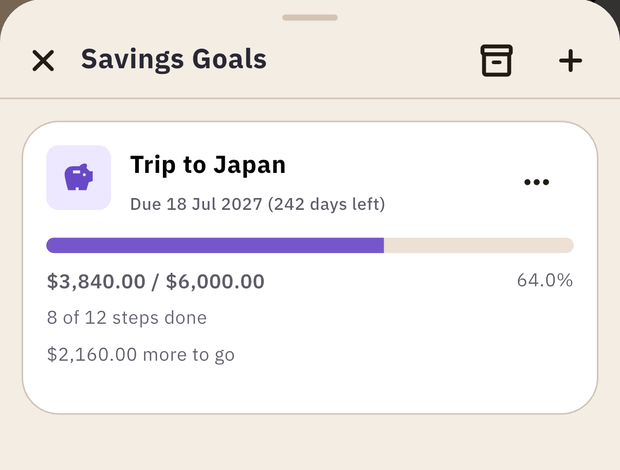
Set a goal, give it a name, and put in whatever you can. The day you want a plan with a chart, switch to one and the money you have already saved stays where it is. Offline. Free, no sign-up needed.
If you are ready for a plan,
pick the one that fits your money
All four live in the same app. You can move off saving freely at any time without starting the goal over.
Same amount every time
A little less each time
A share of what comes in
Research cited on this page
- Sharif, M. A., & Shu, S. B. (2019). Nudging persistence after failure through emergency reserves. Organizational Behavior and Human Decision Processes.
- Silverman, J., & Barasch, A. (2023). On or Off Track: How (Broken) Streaks Affect Consumer Decisions. Journal of Consumer Research, 49(6), 1095–1117.
- Soman, D., & Zhao, M. Journal of Marketing Research · as summarised by David McKenzie, World Bank Development Impact.
- Dai, H., Milkman, K. L., & Riis, J. (2014). The Fresh Start Effect: Temporal Landmarks Motivate Aspirational Behavior. Management Science.
This page is a tool for building a saving habit, not investment advice. Every figure comes from the work cited above. If I have read one wrong, tell me.