 DuckSave
The 52 week money challenge,
done backwards
The usual chart puts in $1, then $2, then $3, and finishes with the biggest weeks in December — exactly when spending peaks and people quit. Backwards does the opposite: week one is $52, and it falls to $1 by the end of the year. The total is the same to the dollar, $1,378.
here Written by HUMBURRER (ณัฐพล เนี่ยงจิต)
I make DuckSave · Updated 20 November 2026
What “backwards” means, and how it differs from the usual chart
The 52 week money challenge most people have seen starts at $1 in week one and adds a dollar every week, until the last week asks for $52. Backwards uses the same 52 amounts, only in reverse order — week one is $52, and it comes down a dollar at a time until week 52 asks for $1.
Because the amounts are the same, the total is identical at $1,378. What changes is not the money. It is when the hard part lands.
Weekly amounts running backwards — $52 in week one, falling to $1 in the last week.
Why the heavy weeks belong at the start
The forward chart puts the most expensive weeks at the end of the year, which happens to be when people spend the most — gifts, parties, travel, time off. That is also when most people quit.
Running it backwards moves the hardest weeks to the start, while the motivation is still there, and leaves the smallest amounts for the end. By December you are putting away $1 to $5 a week, which takes no decision at all.
The difficulty does not disappear. It moves — your first month is the most expensive one.
I wrote that line into the app as well, because it is something to know before you start, not something to find out in week three. January alone asks for $202. If January is already tight for you, backwards is the wrong version — use the same amount every time instead.
If you quit halfway, which version leaves you more?
Both versions finish at the same number. What happens on the way there is not the same, and that matters, because most people do not finish the year. What you walk away with when you stop is the number worth looking at.
| Stopped at | Backwards | Forward | Difference |
|---|---|---|---|
| Week 13 | $598 | $91 | $507 |
| Week 26 | $1,027 | $351 | $676 |
| Week 39 | $1,287 | $780 | $507 |
| Week 52 | $1,378 | $1,378 | $0 |
Stop after three months and backwards leaves you $598. Forward leaves you $91 — 6.6 times less.
That is the whole case for running it backwards. Not that it saves more. It gives you the money earlier, in case you do not finish.
The full 52 week chart, with running totals
The running total is what you have after that week’s deposit. Print this page and tick the boxes one at a time.
| Week | Put in | Running | Week | Put in | Running |
|---|---|---|---|---|---|
| 1 | $52 | $52 | 27 | $26 | $1,053 |
| 2 | $51 | $103 | 28 | $25 | $1,078 |
| 3 | $50 | $153 | 29 | $24 | $1,102 |
| 4 | $49 | $202 | 30 | $23 | $1,125 |
| 5 | $48 | $250 | 31 | $22 | $1,147 |
| 6 | $47 | $297 | 32 | $21 | $1,168 |
| 7 | $46 | $343 | 33 | $20 | $1,188 |
| 8 | $45 | $388 | 34 | $19 | $1,207 |
| 9 | $44 | $432 | 35 | $18 | $1,225 |
| 10 | $43 | $475 | 36 | $17 | $1,242 |
| 11 | $42 | $517 | 37 | $16 | $1,258 |
| 12 | $41 | $558 | 38 | $15 | $1,273 |
| 13 | $40 | $598 | 39 | $14 | $1,287 |
| 14 | $39 | $637 | 40 | $13 | $1,300 |
| 15 | $38 | $675 | 41 | $12 | $1,312 |
| 16 | $37 | $712 | 42 | $11 | $1,323 |
| 17 | $36 | $748 | 43 | $10 | $1,333 |
| 18 | $35 | $783 | 44 | $9 | $1,342 |
| 19 | $34 | $817 | 45 | $8 | $1,350 |
| 20 | $33 | $850 | 46 | $7 | $1,357 |
| 21 | $32 | $882 | 47 | $6 | $1,363 |
| 22 | $31 | $913 | 48 | $5 | $1,368 |
| 23 | $30 | $943 | 49 | $4 | $1,372 |
| 24 | $29 | $972 | 50 | $3 | $1,375 |
| 25 | $28 | $1,000 | 51 | $2 | $1,377 |
| 26 | $27 | $1,027 | 52 | $1 | $1,378 |
Want a total other than $1,378?
A 52 week chart always totals the step × 1,378. Take any target, divide it by 1,378, and round up to a clean step.
| Step | First week | Last week | Year total |
|---|---|---|---|
| $0.50 | $26 | $0.50 | $689 |
| $1 | $52 | $1 | $1,378 |
| $2 | $104 | $2 | $2,756 |
| $5 | $260 | $5 | $6,890 |
Want $5,000? Divide by 1,378 and you get 3.63, so round up to a $4 step. Week one is $208 and the year ends at $5,512 — a little over, which beats coming up short in December.
What it is good at, what it costs you, and who it suits
This version trades an easy December for a hard January. Both sides are here so you can decide before you start, not in week three.
- Gives you the money early, in case you stop — $598 after three months against $91
- The amounts get lighter all year. December runs $1 to $5 a week
- The most expensive stretch of the year becomes the lightest stretch of saving
- The total matches the forward version to the dollar. You save no less
- Every week's amount is known in advance, because the chart is fixed
- January is the most expensive month, at $202
- The difficulty does not disappear, it moves
- A chart has boxes to miss, and missed boxes are what make people quit
- You cannot set an automatic transfer, because the amount changes every week
- Start in a month that is already tight and it breaks in week one
- You have started a 52 week chart before and quit near the end
- Money arrives at the start of your year — a bonus, a tax refund
- You know you tend to stop halfway, so you want the money early
- You want to watch the total climb fast in the first three months
- You have a steady paycheck and can take a heavy first month
- January is already tight — use the same amount every time instead
- Your income changes from month to month
- You want to set one automatic transfer and never think about it
- Empty boxes on a chart take the wind out of you
When you miss a week
Let the app count it instead
Don't want to print anything?
Let DuckSave count
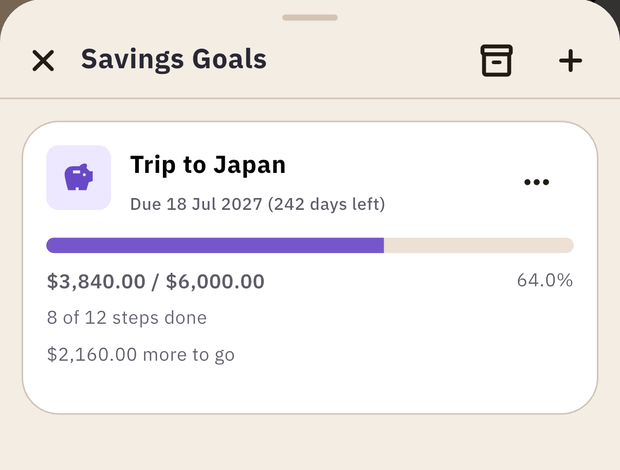
Set a goal and pick A little less each time. The app works out every week's amount for you. Tick it when the money actually goes in, and the running total is there every time. Change the goal and it works the amounts out again. Offline. Free, no sign-up needed.
If backwards is not for you,
one of the other three may be
All four live in the same app, and you can switch at any time without starting the goal over.
This page is a tool for building a saving habit, not investment advice. Every number here is worked out from the formula and checked. If you find one that is wrong, tell me.